
The Ministry of Lands and Natural Resources has announced sweeping reforms aimed at restoring integrity, transparency, and accountability in the management of public lands, following the conclusion of an eight-month nationwide review of allocations and leases.
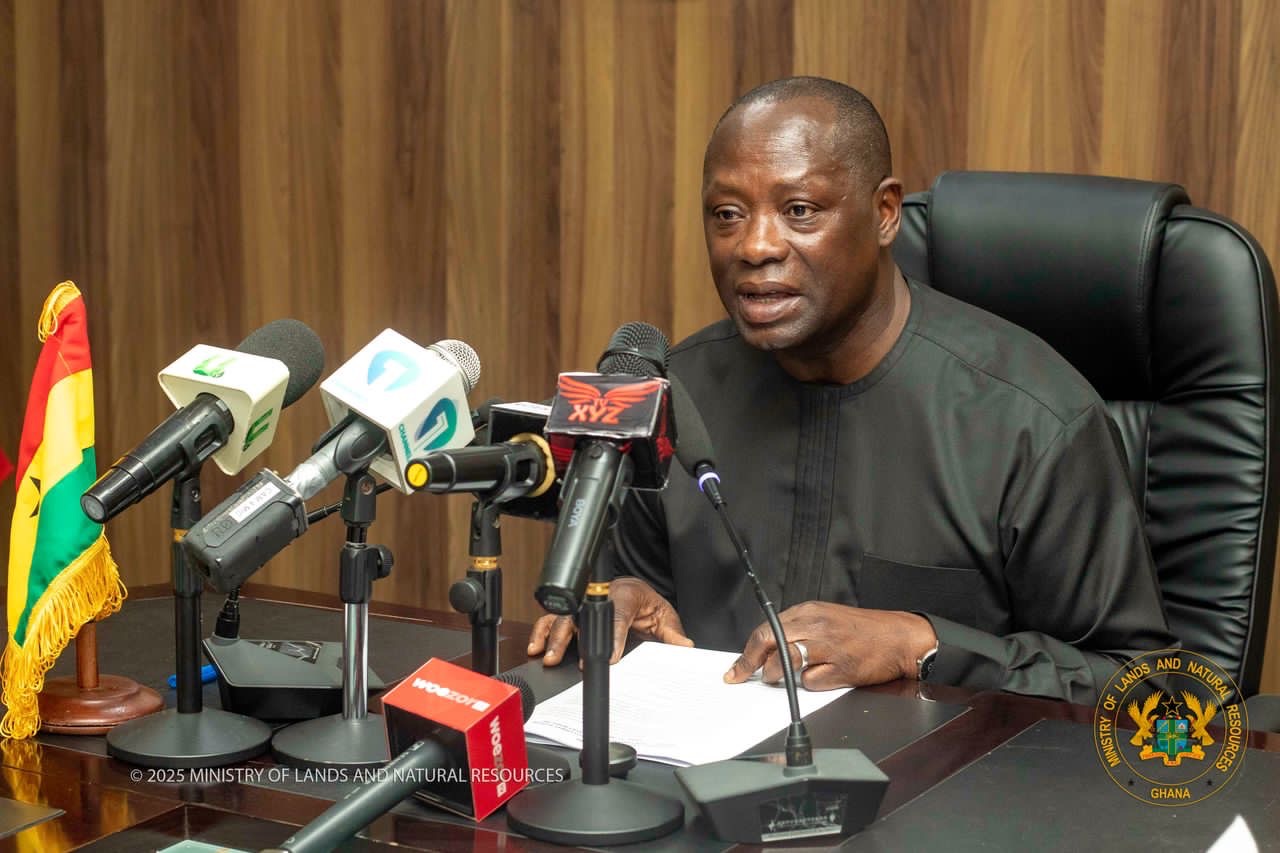
At a press briefing, the sector minister expressed appreciation to members of the Review of Public Lands Committee — including the Deputy Minister, Chief Director, and other officials — for their work on behalf of John Dramani Mahama and the people of Ghana. He also acknowledged the contributions of experts such as Professor Bruce Kofi Bwana Yakubu and Reverend Dr. Lawrence Tete, describing the committee’s work as pivotal to rebuilding public trust in land governance.
Presidential Directive and Committee Review
The reforms trace back to a directive issued by President Mahama on January 10, 2025, ordering an immediate suspension of all activities related to the lease and processing of public lands. The move was intended to protect state lands from abuse and restore discipline within the land administration system.
A five-member committee was subsequently inaugurated on June 5, 2025, to conduct a comprehensive audit of public land allocations nationwide. The committee reviewed 8,160 lease applications across all 16 regions, including 4,176 direct allocations, 2,799 regularizations, and 108 land swap or public-private partnership arrangements.
The findings revealed significant breaches of internal procedures at the Lands Commission, raising concerns about transparency, accountability, and public confidence.
Immediate Corrective Measures
As part of urgent interventions, all uncompleted transactions have been cancelled, while completed regularization applications have been suspended pending further review. Completed transactions will now undergo case-by-case assessment, with any allocations found to have violated due process subject to revocation.
To improve transparency, the ministry will publish region-by-region lists of both completed and uncompleted applications. Affected applicants will be allowed to reapply once the reform process is finalized.
Standardized Application Process
The review identified inconsistencies in public land application procedures across regional offices. In response, the ministry, working with the Lands Commission, has revised Form 5 to serve as the sole mandatory application form for all public land transactions nationwide.
The updated form will soon be available on the Lands Commission’s official website for download and electronic submission.
Stronger Controls and Legal Reforms
The ministry has completed a review of the Lands Commission’s internal processes, clearly outlining each stage of the allocation procedure and strengthening oversight mechanisms. Under the new framework, no public land will be allocated without prior written approval from the Minister for Lands and Natural Resources.
These procedures, along with the revised application form, will be incorporated into a draft Land Regulation to be submitted to Parliament for legislative backing, aimed at preventing a recurrence of past irregularities.
New Valuation and Premium Framework
The committee also uncovered disparities in land valuation, with premiums ranging from as little as one percent to 30 percent of assessed market value.
To address this, a new pricing framework mandates that at least 70 percent of a public land’s assessed market value be paid upfront as a premium, with the remaining 30 percent structured as ground rent over the lease term.
The ministry will collaborate with professional valuers to determine accurate market values nationwide and publish reliable data for designated land clusters on the Lands Commission’s website, eliminating arbitrary pricing practices.
Clarification on User Rights
The ministry clarified that state institutions and companies granted public lands possess only user rights, not ownership, and cannot engage in any transactions involving such lands without prior written approval from the sector minister.
Public Land Protection Task Force
To safeguard lands under review, a Public Land Protection Task Force will be established in partnership with the Lands Commission, the Ministry of Works and Housing, the ministry responsible for water resources, the Ghana Police Service, and selected private sector representatives.
The task force will be responsible for preventing encroachment, halting unauthorized developments, and enforcing compliance in accordance with the Constitution, the Lands Commission Act, the Land Act 1036, and relevant criminal laws.
Digitalization and Decentralization
Concluding the briefing, the minister reaffirmed the government’s commitment to decentralizing and modernizing land administration. The ministry has secured full retention of the Lands Commission’s internally generated funds, with 67 percent allocated to support a national land bank and digitization project.
According to the minister, the digital transformation will enable citizens to access land services directly, without reliance on intermediaries, and ultimately restore public confidence in the management of public lands for current and future generations.
Story by: Emmanuel Asiedu (0247220948) | Follow our social media handles @uktvghana | DM us for Ads on our website or any of our socials