

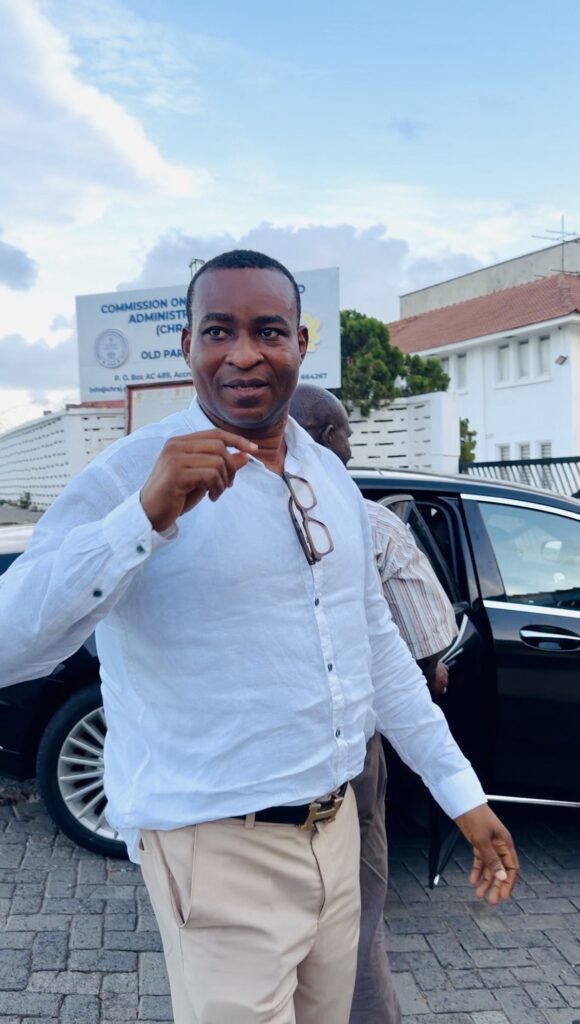
Bernard Antwi Boasiako — popularly known as Chairman Wontumi and Ashanti Regional Chairman of the New Patriotic Party — has been convicted by the Accra High Court over illegal mining-related offences and sentenced to 20 years’ imprisonment.
The judgment, delivered on Monday by Justice Audrey Kocuvie-Tay, found Chairman Wontumi and his company, Akonta Mining Limited, guilty on four counts connected to the unauthorized assignment of mineral rights and facilitating unlicensed mining operations at a mining concession in Samreboi.
According to the court, the prosecution successfully proved that Chairman Wontumi and Akonta Mining allowed Henry Okoom and Michael Gyedu Ayisi to conduct mining activities on the company’s concession without obtaining prior approval from the Minister for Lands and Natural Resources.

The court held that by granting such permission, the accused facilitated illegal mining on the concession.
In addition to the 20-year prison sentence, Chairman Wontumi was fined GH¢120,000. Failure to pay the fine will result in an additional three-year prison term. Akonta Mining Limited was also fined GH¢180,000 on two counts.
Justice Kocuvie-Tay stated that the court relied heavily on circumstantial evidence in reaching its verdict. The judge noted that the defence did not contest the absence of ministerial approval for the mining activities, describing the omission as an implicit admission because no application for approval had been made by the company.
Chairman Wontumi had argued during the trial that he only granted Henry Okoom permission to reclaim degraded land by planting coconut trees and not to engage in mining. He further claimed that he was unaware Okoom was a small-scale miner and believed him to be a mine support service provider.
The court rejected this explanation, finding that Chairman Wontumi failed to provide evidence of Okoom’s alleged reclamation expertise. The judge also cited Okoom’s unchallenged testimony that he mined portions of the concession to recover costs after Chairman Wontumi allegedly failed to provide funds for reclamation work.
Applying the principles of circumstantial evidence established in Duah v The Republic [1987-88] 1 GLR 343, the court concluded that no reasonable explanation existed to contradict the finding that Chairman Wontumi knowingly permitted Okoom to mine on the concession.
The judge also dismissed Chairman Wontumi’s later claim that Okoom was expected to recover his costs through the future sale of matured coconut trees, describing the explanation as an afterthought.
In a significant aspect of the ruling, the court lifted the corporate veil of Akonta Mining Limited, citing the legal precedent in Morkor v Kuma. The court found that there was no functioning management or executive board within the company and held that Chairman Wontumi was the de facto holder of the mineral rights and the sole controlling mind behind the company’s operations during the period the offences were committed.
“The A3’s corporate veil should be lifted as there is no real difference between the two (Chairman Wontumi and Akonta) in relation to dealing with the persons permitted to mine,” Justice Kocuvie-Tay ruled.
During sentencing, several lawyers appealed to the court for mitigation and urged the judge to impose the minimum sentence available under the law.

Story by: Ernest Frimpong (0247220948) | Follow our social media handles @uktvghana | DM us for Ads on our website or any of our socials